Triglycerides are an important component of our blood profile. Even though it is often mentioned together with cholesterol, triglycerides have different roles and impacts on body health. Visit the Ministry of Health’s MyHealth portal for other important health information at www.myhealth.gov.my/
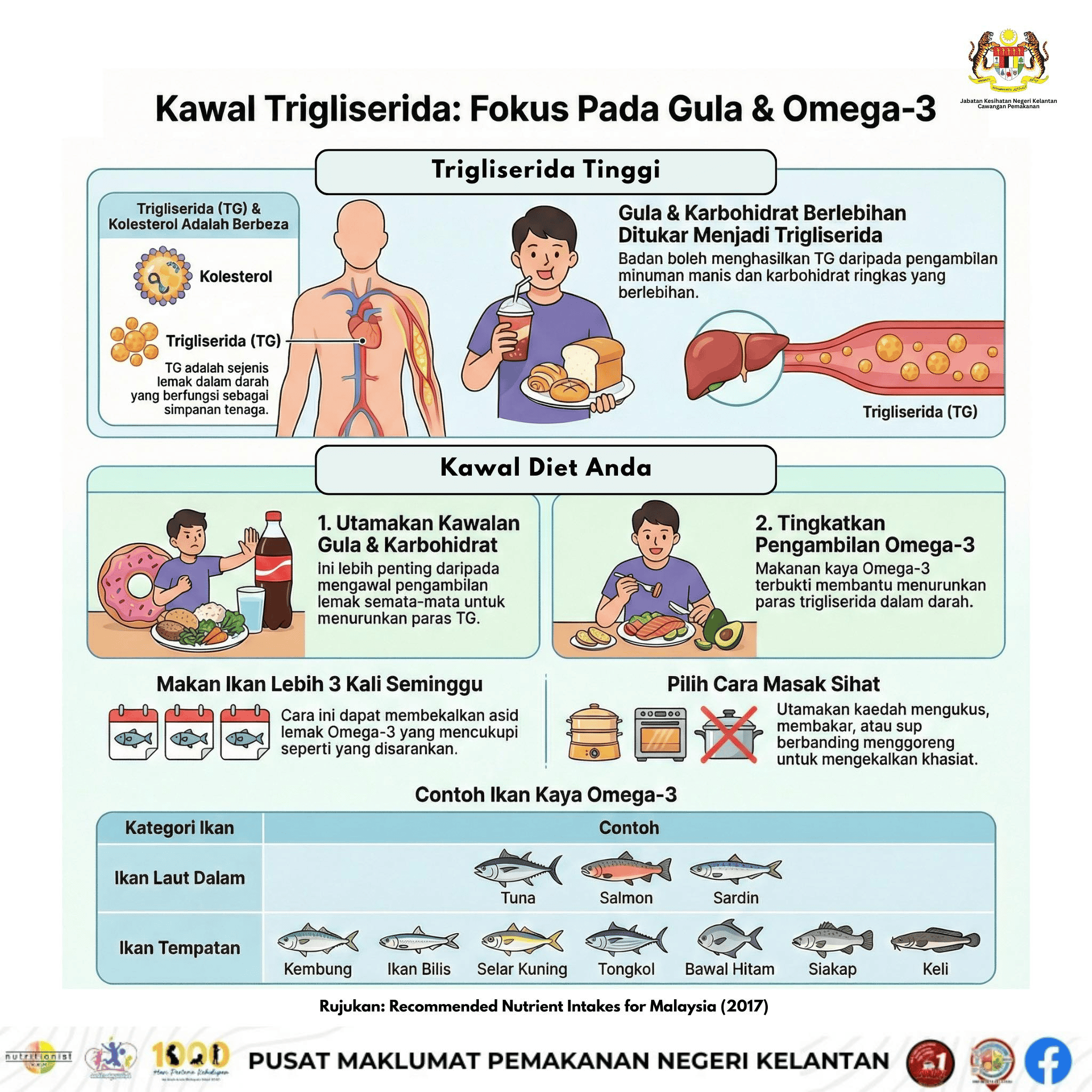
Triglycerides are a type of fat in the blood that is important as a source of energy, but if it is too high it can increase the risk of heart attack, stroke and inflammation of the pancreas.
See the full distribution below.
What are Triglycerides?
Triglycerides are a type fat (lipid) which is mainly found in your blood.
When you eat, your body converts unused calories into triglycerides. This fat is stored in your fat cells.
When the body needs energy between meals, the hormone will release triglycerides to be used as fuel.
However, if you regularly consume more calories than you burn (especially from carbohydrates and fats), you may experience high triglyceride levels in your blood (hypertriglyceridemia).
Simply put, triglycerides are the main form of fat that is formed when excess calories (mainly from carbohydrates and sugar) are stored by the body for later use as energy.
Produced in the liver and also derived from fatty and sugary foods, excess that is not used is stored in fat cells.

Difference between Triglycerides and Cholesterol
Triglycerides and cholesterol are two types of fat in the blood that are often tested for heart health, but they both have different functions and effects.
| Aspect | Triglycerides | Cholesterol |
|---|---|---|
| Main function | Source of energy when hungry or exercising | Helps make hormones, fat digestion |
| Food source | High carbohydrate (white rice, sugar, sweet snacks) licter +1 | Saturated fats (red meat, butter) keslan.kemkes+1 |
| How to send | In VLDL (fat energy) | In LDL (bad) & HDL (good) |
| Normal range | Below 150 mg/dL | Total below 200 mg/dL |
| The risk if high | Inflammation of the pancreas, obesity | Blocked arteries, heart attack |
| How to download | Reduce sugar, exercise 30 minutes/day | Eat high fiber, increase HDL |
What is a Normal Triglyceride Reading?
A blood test (lipid profile) will usually show your triglyceride levels. The following are general guidelines according to medical standards shared by Public Health Malaysia
Triglycerides (TG): good <1.7, borderline 1.7–2.2, high 2.3–5.6, very high ≥5.6.
| Category | mmol/L | mg/dL |
| Normal (Good) | Less than 1.7 | Less than 150 |
| Border (Border Line) | 1.7 – 2.2 | 150 – 199 |
| Tall | 2.3 – 5.6 | 200 – 499 |
| Very high | 5.6 and above | 500 and above |
Causes of High Triglyceride Readings
High triglyceride levels are often caused by a combination of lifestyle, diet, and other controllable health factors. The main causes include excessive calorie intake and an inactive lifestyle.
Here are some of the main reasons why a person’s triglyceride numbers can be high:
1. Unhealthy Eating Habits
- Excessive Sugar Intake: Sweet foods and drinks (carbonated water, candy) are quickly converted by the liver into triglycerides.
- Simple Carbohydrates: Foods such as white rice, white bread and products made from wheat flour are quickly processed into sugar, then stored as fat.
- Saturated Fats & Trans Fats: Regularly consume fried foods, excessive coconut milk and animal fats.
2. Lifestyle
- Excess Calories: Consuming more calories than the body burns. Unused calories are stored as triglycerides.
- Lack of Physical Activity: Rarely exercising means the body does not have the opportunity to burn fat deposits in the blood.
- Alcohol Intake: Alcohol has a high sugar and calorie content so it stimulates the liver to produce more triglycerides.
3. Health Problems & Diseases
- Obesity: Especially fat that accumulates in the stomach (visceral fat).
- Stage 2 Diabetes: Uncontrolled blood sugar is often accompanied by high triglyceride levels.
- Hypothyroidism: An underactive thyroid gland disrupts fat metabolism in the body.
- Kidney or Liver Disease: Disorders of this organ affect the filtering and processing of lipids in the blood.
4. Genetic Factors & Drugs
- Hereditary Factors: Some individuals inherit genetic conditions (eg familial hypertriglyceridemia) which causes the body to produce too much triglycerides.
- Drug Side Effects: Use of certain medications such as steroids, diuretics, birth control pills, or high blood pressure medications (beta-blockers) can increase lipid readings.
5. Age & Gender Factors
- Menopause: Hormonal changes in women after menopause can cause increased levels of fat in the blood.
- Age Increase: Triglyceride levels tend to increase with age.
Adverse Effects of High Triglyceride Readings
Long-term high triglyceride readings are not just numbers on a laboratory report, but are an early warning of internal organ damage.
Here are some risks of a high triglyceride reading:
- Atherosclerosis (blocked arteries): Excess fat sticks to the walls of the arteries, causing them to narrow and increasing the risk of heart attack and stroke.
- Inflammation of the pancreas (pancreatitis): Levels >500 mg/dL trigger severe stomach pain, vomiting, and can be life-threatening if not treated quickly.
- Fatty liver disease: Fat builds up in the liver, causing long-term hepatitis or cirrhosis of the liver.
- Metabolic syndrome & diabetes: Combined with obesity, high blood pressure and uncontrolled blood sugar.
- Peripheral artery disease: Lack of blood flow to the legs, causing pain, numbness or ulcers.
- Skin problems: Yellow lumps (xanthoma) on the skin or eyelids if the level is very high.
- Abnormal heart rhythm: Increases the risk of arrhythmia and heart failure.

How to Control/Lower Triglycerides Naturally
1. Control Sugar and Carbohydrates
Controlling sugar intake is more important than simply controlling fat intake to reduce triglyceride levels.
The body produces triglycerides (TG) from excessive consumption of sweet drinks and simple carbohydrates.
Prioritize controlling sugar and carbohydrates in your daily diet to reduce TG production by the body.
2. Increase Omega-3 Uptake
Foods rich in Omega-3 fatty acids have been scientifically proven to help lower triglyceride levels in the blood.
You are advised to eat fish more than 3 times a week to supply sufficient Omega-3 fatty acids.
Choose fish rich in omega-3 such as deep sea fish (such as tuna, salmon, sardines) and many local fish such as mackerel, anchovies, yellow seal, cod, black pomace, red fish, stingrays, sea bream, catfish and catfish.
3. Choose Healthy Cooking Methods
The way food is prepared plays an important role in maintaining good fatty acid nutrition and avoiding excess fat.
Reduce or avoid frying to ensure the nutrients are maintained. Prefer steaming, grilling, or soup methods.
Further information
For the latest information regarding health, please visit the Ministry of Health’s MyHealth portal at www.myhealth.gov.my/
Or follow the sharing on the following social media:
Triglycerides FAQ
No, both are different types of fat (lipid) in the blood. Cholesterol is used to build cells and hormones, while triglycerides (TG) function specifically as energy storage for the body.
The main cause is excessive consumption of sugar and carbohydrates. When you consume excessive amounts of sweet drinks or simple carbohydrates (such as white rice or bread), the body will convert them into triglycerides to be stored as fat.
To reduce triglyceride levels, controlling sugar and carbohydrates is more important and critical than controlling fat intake alone.
Sugar Control: Reduce sugary drinks and simple carbohydrates.
Increase Omega-3: Eat fish rich in Omega-3 fatty acids such as Salmon, Pufferfish, Anchovies, or Sea Bass.
Frequency of Eating Fish: It is recommended to eat fish more than 3 times a week.
How to Cook: Use healthy methods such as steaming, grilling, or making soup, and avoid frying to preserve nutrition.
High TG levels can cause hardening of the artery walls, thereby increasing the risk of heart disease and stroke. If the numbers are too extreme (more than 5.6 mmol/L), it can cause dangerous inflammation of the pancreas (pancreatitis).
In Malaysia, mmol/L is used as the standard:
Normal: Less than 1.7 mmol/L.
Border (Border Line): 1.7 – 2.2 mmol/L.
Tall: 2.3 – 5.6 mmol/L.
Very high: 5.6 mmol/L and above.
News
Berita Teknologi
Berita Olahraga
Sports news
sports
Motivation
football prediction
technology
Berita Technologi
Berita Terkini
Tempat Wisata
News Flash
Football
Gaming
Game News
Gamers
Jasa Artikel
Jasa Backlink
Agen234
Agen234
Agen234
Resep
Download Film
Gaming center adalah sebuah tempat atau fasilitas yang menyediakan berbagai perangkat dan layanan untuk bermain video game, baik di PC, konsol, maupun mesin arcade. Gaming center ini bisa dikunjungi oleh siapa saja yang ingin bermain game secara individu atau bersama teman-teman. Beberapa gaming center juga sering digunakan sebagai lokasi turnamen game atau esports.