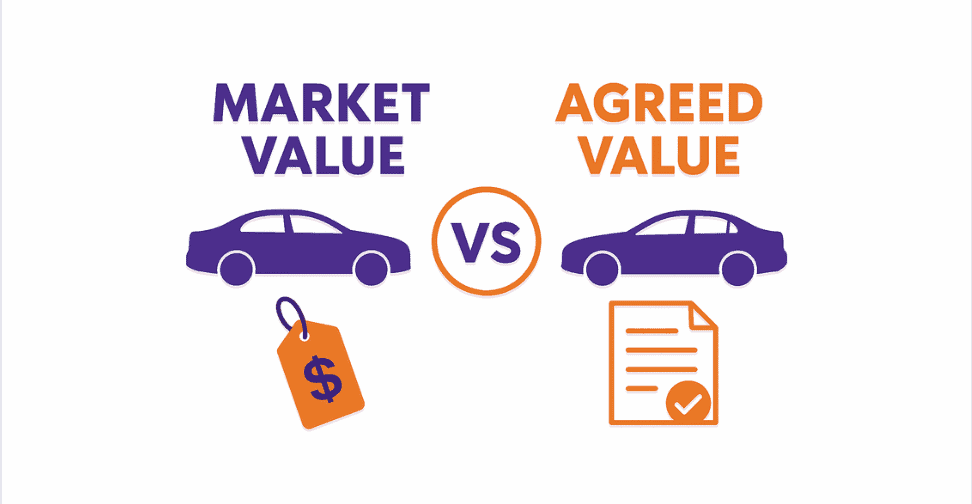
Understanding the difference in car insurance between “Agreed Value” and “Market Value” is an important step that is often overlooked by vehicle owners, even though this choice can determine the amount of compensation you receive if your car is totally lost or stolen in an accident.
Vehicle owners must have noticed that when you want to renew their vehicle insurance, you can determine the insurance value based on the sum of the “Agreed Value” and “Market Value” but do you know what the difference is between the two?
Many people automatically select insurance rates without realizing that there are two different scoring mechanisms and each has significant financial implications for your coverage.
Understand the concept of “Sum Insured” or Sum Insured

Before delving into the comparison and differences in car insurance prices, it’s a good idea for you to know the term “Sum Insured” or Sum Insured, which is the financial value you set to protect your vehicle.
This value will be the basis for calculating premium and compensation payments. For comprehensive policies, you will usually be given two main options for determining the Coverage Price, namely based on Market Value or Approved Value.
The choices you make are not just numbers on paper, but are strategic decisions that affect your financial protection in the future.
The decision to choose between Agreed Value and Market Value should be made based on a careful assessment of your financial situation and personal preferences.
Understanding the Concept of “Market Value”

Market Value means your car is insured based on the vehicle’s current value at the time the claim is filed, not when the policy was purchased or renewed.
Insurance companies will refer to industry valuation guidelines, such as data from Insurance Services Malaysia (ISM) or their internal sources, to determine the current market price for your vehicle model and year.
This value is constantly changing and takes into account depreciation factors, market conditions and current demand for the car model.
The main advantage of choosing Market Value is that insurance premiums are usually cheaper than Agreed Value and this cost difference may seem small at first, but can save you an annual outlay.
However, the biggest weakness is the uncertainty in the amount of compensation.
If your car is declared completely lost or stolen, the insurance company will pay based on the market value at the time of the incident, which must be lower than the value at the beginning of the policy due to depreciation.
This means that even if the Sum Insured on your policy is RM50,000, you can only receive RM40,000 if the market value of your car decreases at the time of claim and this situation becomes even more detrimental if you still have a high bank loan balance.
For example, if your car is covered with a market value of RM50,000, but after a few months the car is stolen and the current market value is only RM40,000, while your remaining debt to the bank is still RM44,000, then you have to cover the RM4,000 shortfall from your own money.
This risk is called negative equity and is a financial trap that is often overlooked by car owners who are simply chasing cheap premiums.
Understanding the Concept of “Agreed Value”

Different from Market Value, Agreed Value is the amount of compensation that has been mutually agreed between you and the insurance company at the beginning of the policy and this amount will remain fixed throughout the coverage period.
This value is determined based on the model, year and several other factors of your vehicle at the time of policy purchase and is often higher than the current market price.
The main advantage of this system is the absolute certainty of the amount of money you will receive in the event of total loss or theft, without having to worry about depreciation or market price fluctuations.
For example, if you choose an Agreed Value of RM55,000 for your 2019 Honda City car, and three months later the car has an accident resulting in a total loss, then the insurance company will pay you the full RM55,000 without any deductions, even though the market value of the car at that time has dropped to RM52,000.
This RM3,000 difference can be significant, especially if it helps you pay off your bank loan balance more comfortably or leaves some extra cash to buy a replacement vehicle.
Although premiums for Agreed Value are typically 5 to 15 percent higher than Market Value, the annual cost difference is often considered a worthwhile payment for peace of mind and understanding the meaning of “agreed value” will make it easier to understand why there is a difference in auto insurance value.
Interesting article: What to Do If Hit by an Uninsured Vehicle?
Making the Right Choice for Your Protection

The decision to choose between Agreed Value and Market Value should be made based on a careful assessment of your financial situation and personal preferences and knowing the difference between the two helps you know the difference in the amount of car insurance you pay.
If you have a regular model car where depreciation is predictable, such as a Perodua Myvi or Proton Saga and you are comfortable with the possibility of receiving payments based on market value, then Market Value may be an adequate and economical option.
However, if you have a limited edition vehicle, a new car purchased at a high price, or you still have large loan commitments, Agreed Value is a smarter choice to avoid unwanted financial shocks.
Please note that this option only applies to total loss or theft claims and does not affect partial damage claims which will be paid based on actual repair costs.
You can also change the option from Market Value to Agreed Value whenever your policy expires and you want to renew it.
Be sure to talk to your agent or insurance company about a reasonable Approved Value amount and support it with evidence such as a purchase receipt or appraisal report to avoid disputes later.
PakarPBN
A Private Blog Network (PBN) is a collection of websites that are controlled by a single individual or organization and used primarily to build backlinks to a “money site” in order to influence its ranking in search engines such as Google. The core idea behind a PBN is based on the importance of backlinks in Google’s ranking algorithm. Since Google views backlinks as signals of authority and trust, some website owners attempt to artificially create these signals through a controlled network of sites.
In a typical PBN setup, the owner acquires expired or aged domains that already have existing authority, backlinks, and history. These domains are rebuilt with new content and hosted separately, often using different IP addresses, hosting providers, themes, and ownership details to make them appear unrelated. Within the content published on these sites, links are strategically placed that point to the main website the owner wants to rank higher. By doing this, the owner attempts to pass link equity (also known as “link juice”) from the PBN sites to the target website.
The purpose of a PBN is to give the impression that the target website is naturally earning links from multiple independent sources. If done effectively, this can temporarily improve keyword rankings, increase organic visibility, and drive more traffic from search results.