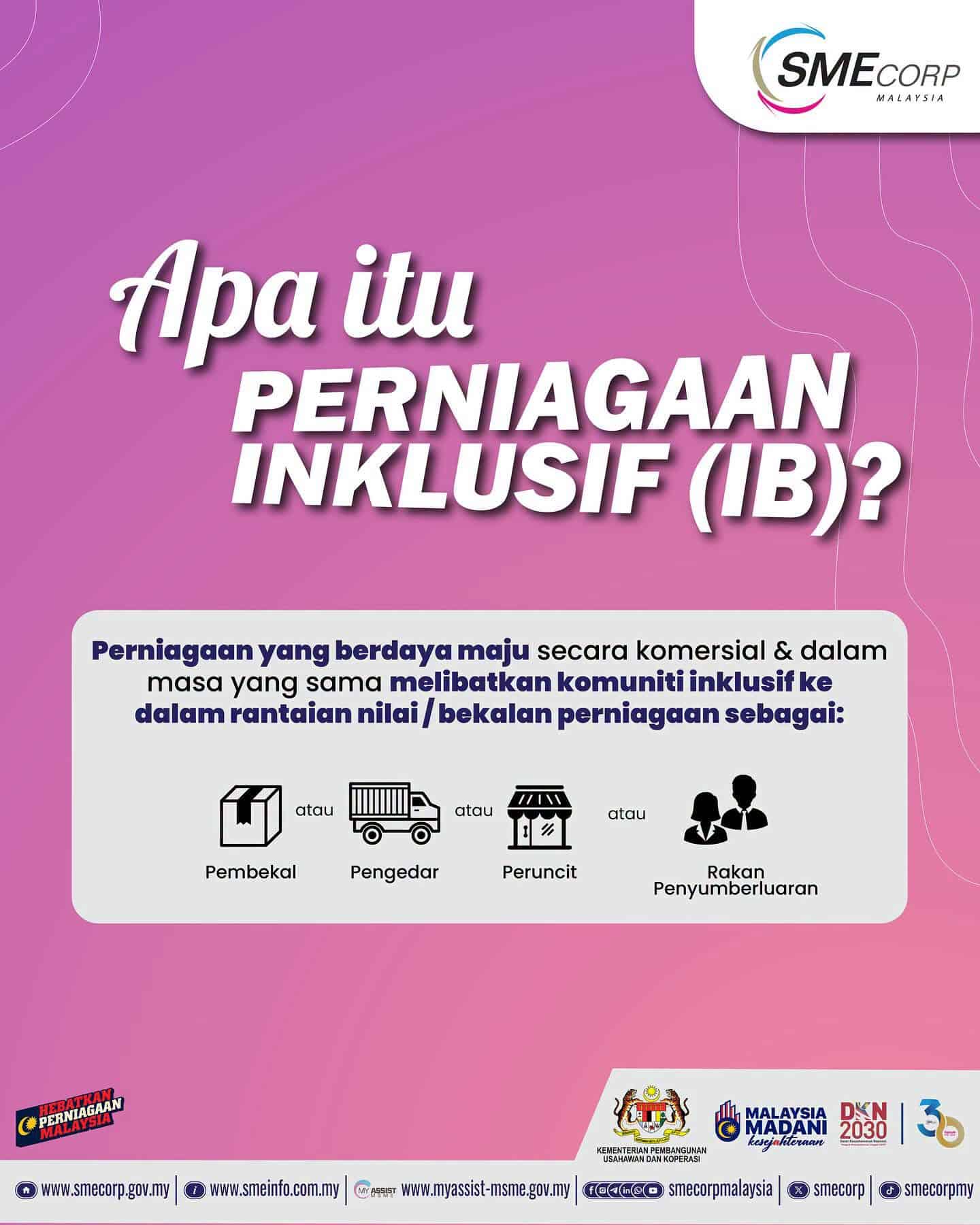
Inclusive Business refers to business models that are commercially viable (profit-making) but at the same time include low-income groups (B40) or marginalized communities into their core value chain.
In Malaysia, this agenda is officially led by the Ministry of Entrepreneurship and Cooperative Development (KUSKOP) together with SME Corp. Malaysia to encourage balanced and sustainable economic growth.
Below is shared more information about Inclusive Business (IB) for your guidance.
What is Inclusive Business (IB)?
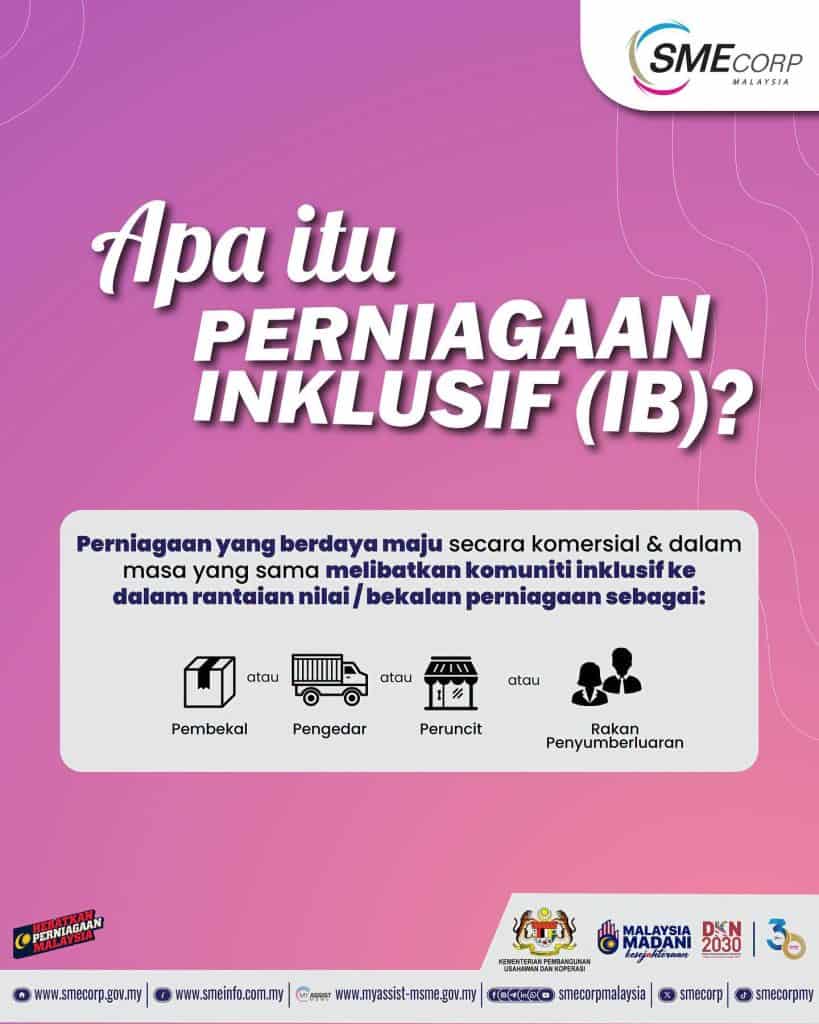
A commercially viable business & at the same time involving an inclusive community into the business value/supply chain as:
- Supplier (or)
- Distributor (or)
- Retailer (or)
- Outsourcing Partners
Inclusive Business Mechanism
IB companies will absorb inclusive communities in their value chains:
- As a Distributor or Retailer: For example, train housewives or rural youth to become sales agents, stockists or official logistics representatives for your company’s products.
- As Supplier: For example, your company buys agricultural products directly from B40 small farmers with a guarantee of fair prices, rather than suppressing their prices.
- As Outsourcing Partner (Outsourcing): For example, your company subcontracts factory work such as product packaging or sewing services to marginalized communities or local disability training centers.
Who is the Inclusive Community?
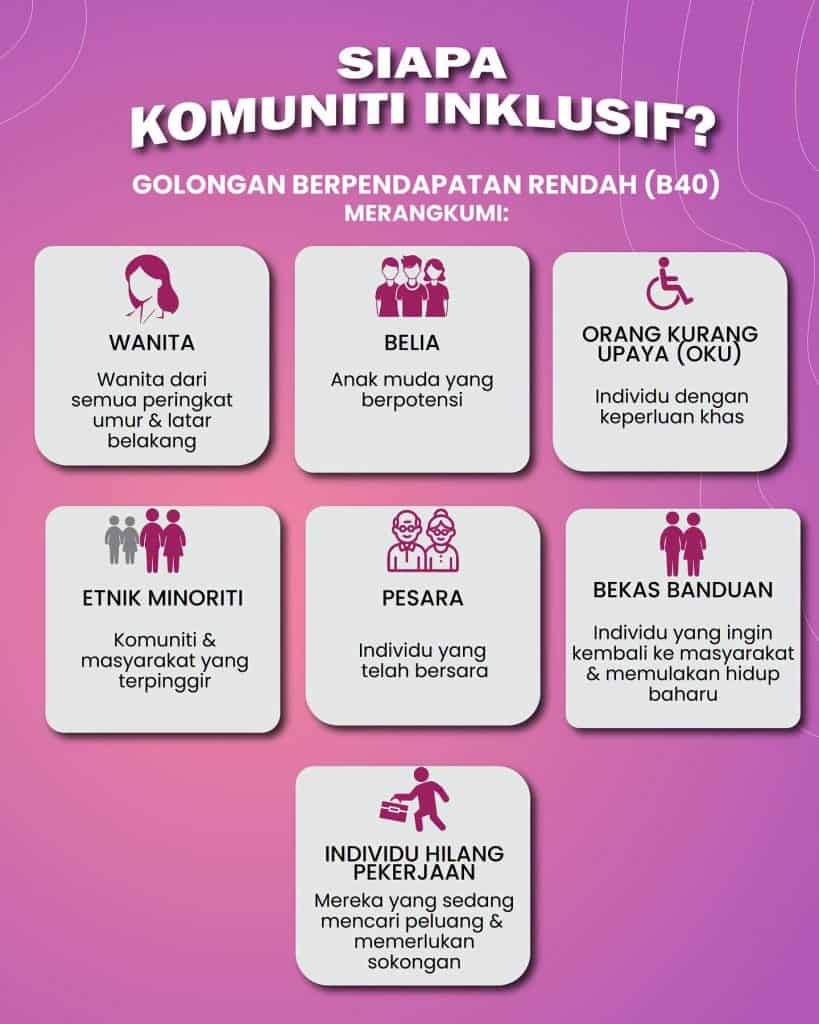
Low income group (B40) which includes:
- WOMAN: Women of all ages & backgrounds
- YOUNG ADULT: Young people with potential
- PERSONS WITH DISABILITIES (OKU): Individuals with special needs
- ETHNIC MINORITIES: Marginal communities & communities
- PENSION: Retired individuals
- FORMER PRISONER: Individuals who want to return to society & start a new life
- INDIVIDUALS LOST JOBS: Those who are looking for opportunities & need support
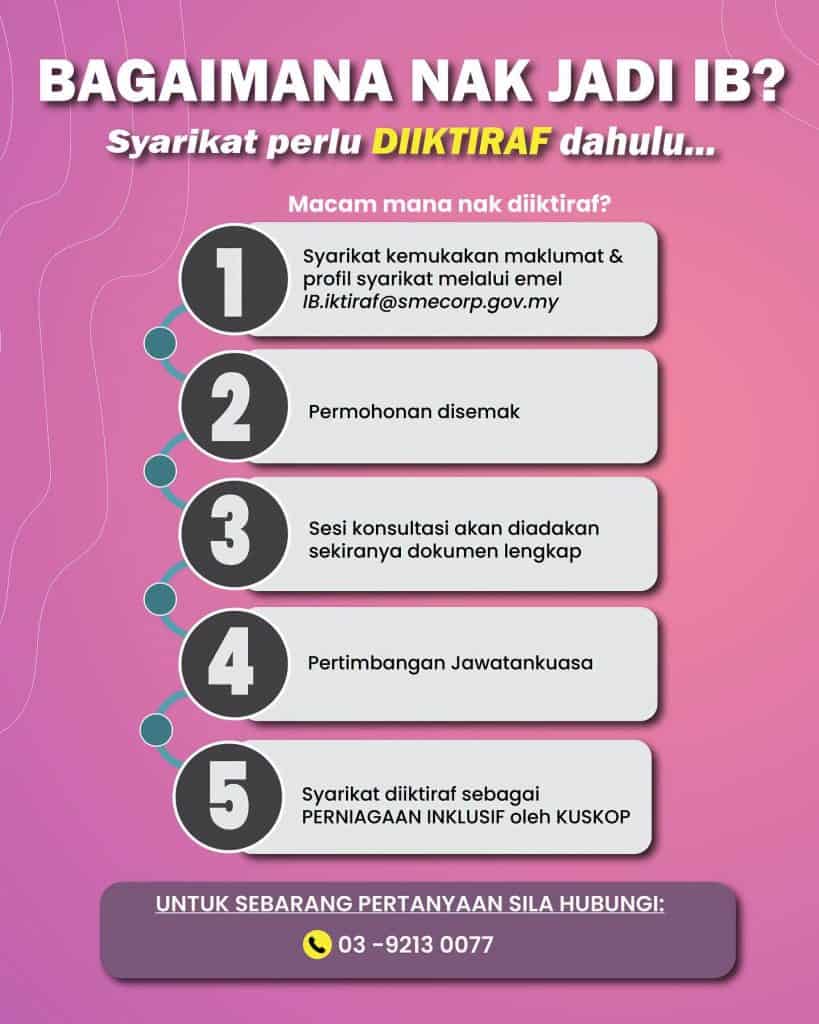
How to Join Inclusive Business (IB) 2026
To become Inclusive Business (IB) in Malaysia for 2026Your company needs to be recognized first. See the methods below:
Step 1: The company conveys company information & profile via email [email protected]
Step 2: Application reviewed
Step 3: A consultation session will be held if the documents are complete
Step 4: Committee Considerations
Step 5: This company is recognized as INCLUSIVE BUSINESS by KUSKOP
More Information and Inclusive Business FAQs
For further information and official references about Inclusive Business (IB)You can visit the official portal SME Corp. Malaysia.
For any questions, please contact: 03-9213 0077
Frequently Asked Questions
– IB is a planned core business model that seeks sustainable full (commercial) profitability, but the operational chain must absorb B40 as a productive partner.
– CSR is benevolent, not profit-based, and depends on the company’s seasonal allocation (donations).
Open to all business entity statuses registered with SSM including PMKS, Multinational Companies (MNCs), and Government Linked Companies (GLCs)
Not mandatory. This status approval is a voluntary initiative to reward companies that have succeeded in proving their business models have a sustainable social impact on local communities.
Companies may choose to absorb B40, OKU, youth, ethnic minorities, retirees, or ex-convicts into their value chain as:
– Supplier: Buy raw materials directly from B40 micro producers with guaranteed fair prices.
– Distributor: Train people to become licensed sales agents, stockists or logistics managers.
– Retailer: Open a community-friendly market space or small shop.
– Outsourcing Partners: Providing third party sub-contracts (eg: packaging or sewing services).
PakarPBN
A Private Blog Network (PBN) is a collection of websites that are controlled by a single individual or organization and used primarily to build backlinks to a “money site” in order to influence its ranking in search engines such as Google. The core idea behind a PBN is based on the importance of backlinks in Google’s ranking algorithm. Since Google views backlinks as signals of authority and trust, some website owners attempt to artificially create these signals through a controlled network of sites.
In a typical PBN setup, the owner acquires expired or aged domains that already have existing authority, backlinks, and history. These domains are rebuilt with new content and hosted separately, often using different IP addresses, hosting providers, themes, and ownership details to make them appear unrelated. Within the content published on these sites, links are strategically placed that point to the main website the owner wants to rank higher. By doing this, the owner attempts to pass link equity (also known as “link juice”) from the PBN sites to the target website.
The purpose of a PBN is to give the impression that the target website is naturally earning links from multiple independent sources. If done effectively, this can temporarily improve keyword rankings, increase organic visibility, and drive more traffic from search results.