SKDS (Subsidized Diesel Control System ) was introduced to reduce leakage and smuggling of subsidized diesel more effectively.
Visit the official MySubsidi Diesel portal at the following link: for more detailed information.
This system is open to companies and land transport agencies who have the right to purchase subsidized diesel at certain stations using a “fleet card”.
Military and special vehicles used in complex environments such as airports, ports, construction sites, factories and logging not feasible.
Starting May 2026, SKDS registration in the field of goods transportation will be carried out officially expanded to Sabah, Sarawak, and WP Labuan.
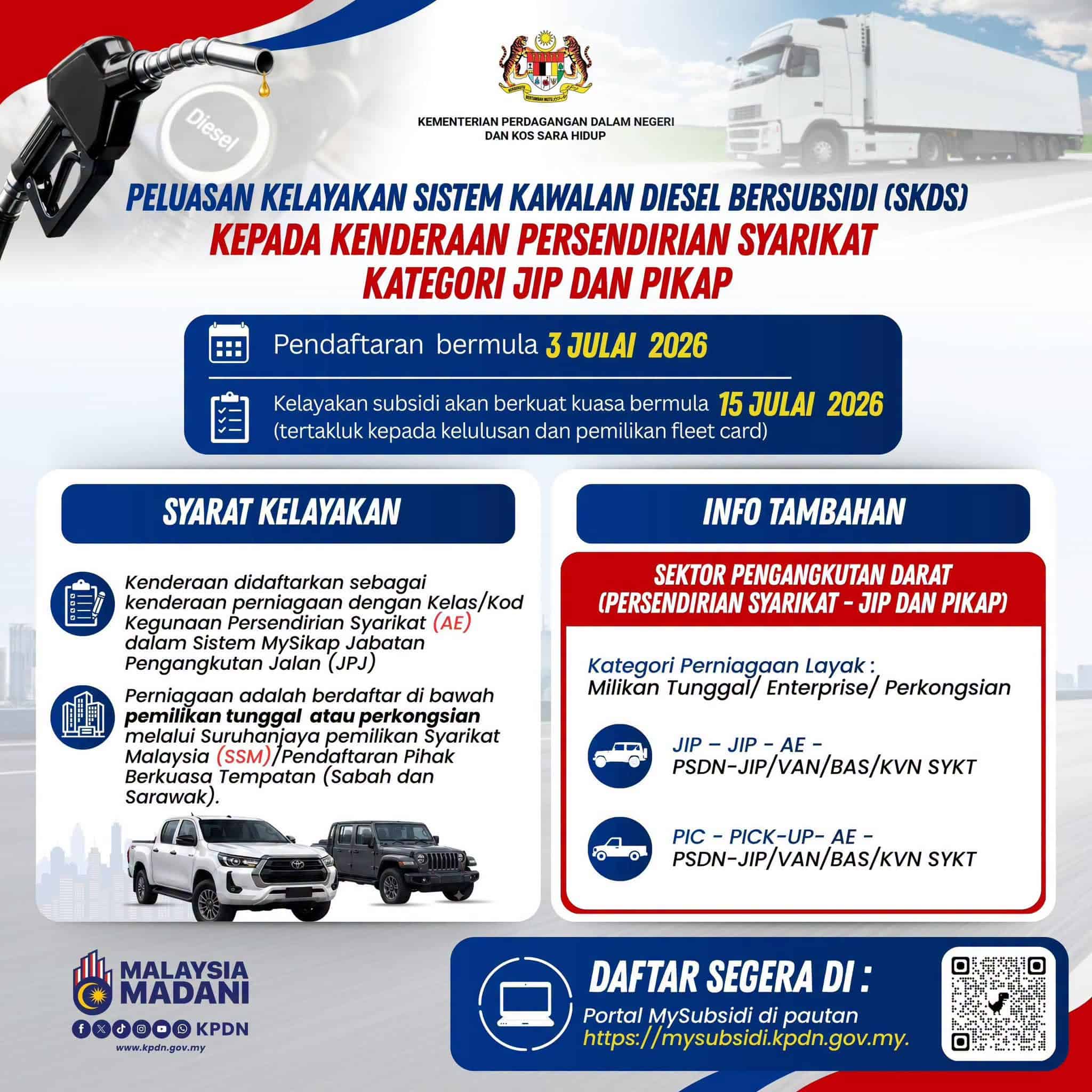
Not only that, the government has also expanded this scheme to include it jeeps and pickup trucks owned by private companies (use AE code).
Check out complete information about SKDS 2.0, requirements and how to apply below.
What is SKDS?
SKDS is a program targeting diesel subsidies under the Ministry of Domestic Trade and Cost of Living (KPDN).
Registration through SKDS will allow eligible companies to continue to benefit from diesel subsidies through this mechanism fleet card at a rate of RM2.15 per liter for the land goods transportation sector and RM1.88 per liter for the general land transportation sector.
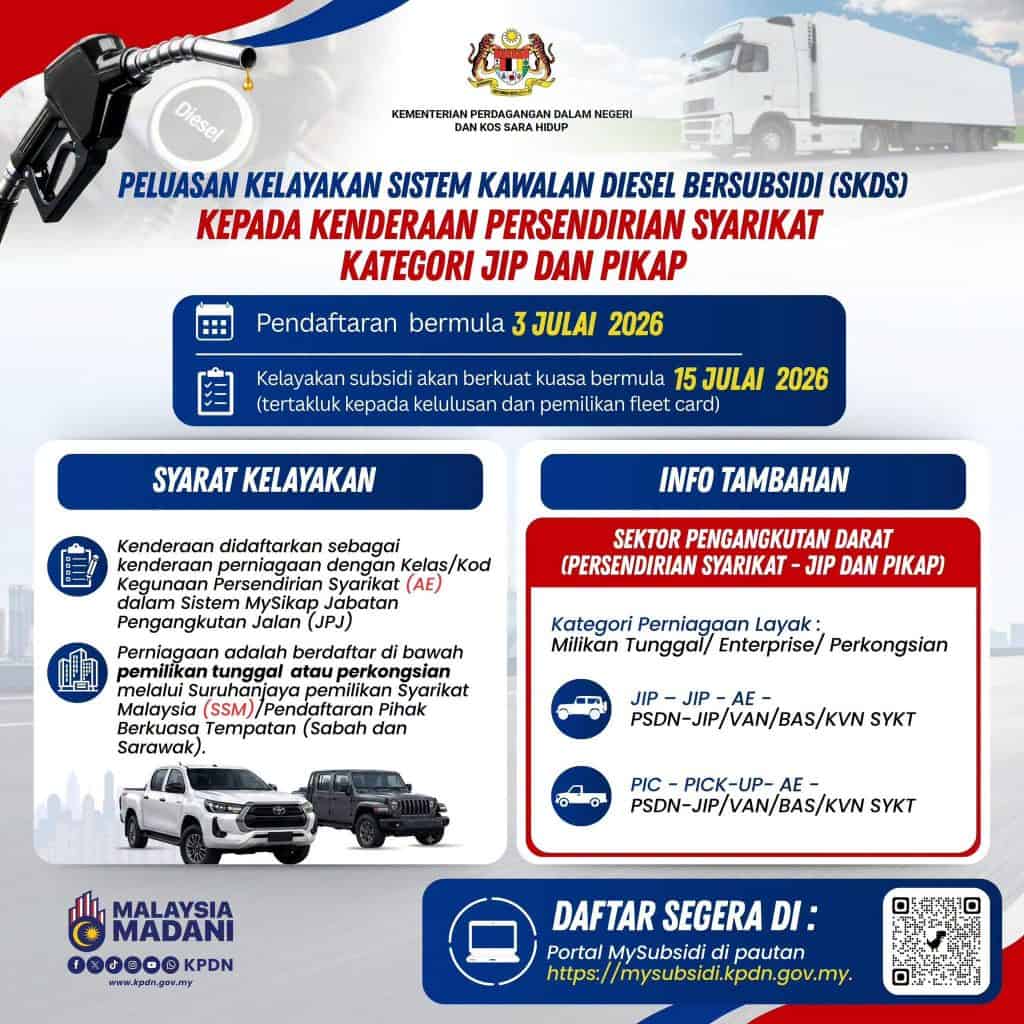
Starting from 3 July 2026, the government has expanded this scheme to cover the following: jeeps and pickup trucks owned by private companies (use AE code) under the land goods transportation sector to help micro and small traders.
Companies that qualify can start enjoying this subsidy rate July 15, 2026 immediately upon receipt fleet card each.
The addition of this new sector means that all types and classes of vehicle use involved in the subsidy control system are now total 35 types.
Eligibility Requirements for Submitting SKDS 2.0
Requirements for submitting SKDS 2.0 subsidized diesel via the KPDN MySubsidi portal are as follows:
- Business Entity Registration:
- The business must be registered as a sole proprietorship or partnership with the SSM, or Local Authority registration for Sabah and Sarawak.
- Vehicle Ownership:
- Diesel vehicles must be legally registered below name of the company or business entity who is applying (Not individual names).
- Active Road Tax:
- Have a valid and active Motor Vehicle License (LKM/road tax) from the Road Transport Service (JPJ).
- Transport Agent Registration:
- For commercial trucks, the vehicle must be registered as a commercial vehicle with the Land Public Transport Agency (APAD) or Sabah/Sarawak Commercial Vehicle Licensing Agency (LPKP).
- Vehicle Type:
- The vehicle type must be listed in its entirety 35 vehicle types/use classes approved. It also includes 23 existing types of real goods vehicles business jeep and pickup truck categories with the Company’s Private Use Class Code (AE) for which applications have just been opened July 3, 2026.
For applications in the jeep and pickup truck business category that just opened this month, the owner must ensure:
- Vehicles must be registered below Company Personal Use (AE) Class/Code in the JPJ MySikap system.
- Individual owners who use jeeps/pickups for micro businesses are required carry out the process of changing ownership in the name of the business at JPJ first before applying.
- Approval for the jeep and pickup category (AE Code) allows entrepreneurs to enjoy subsidized prices starting at RM2.15 per litre July 15, 2026.
SKDS Fleet Card for Monthly Quota Determination
The government has set a fixed monthly consumption quota fleet card for goods and commercial vehicles.
The subsidized diesel quota limit given is between 900 liters to 5,000 liters per month.
This liter allocation amount is automatically evaluated by the system based on vehicle type, engine capacity (cc), weight with load (BDM), and daily operating patterns business.
Claim a Cash Refund (Reimbursement)
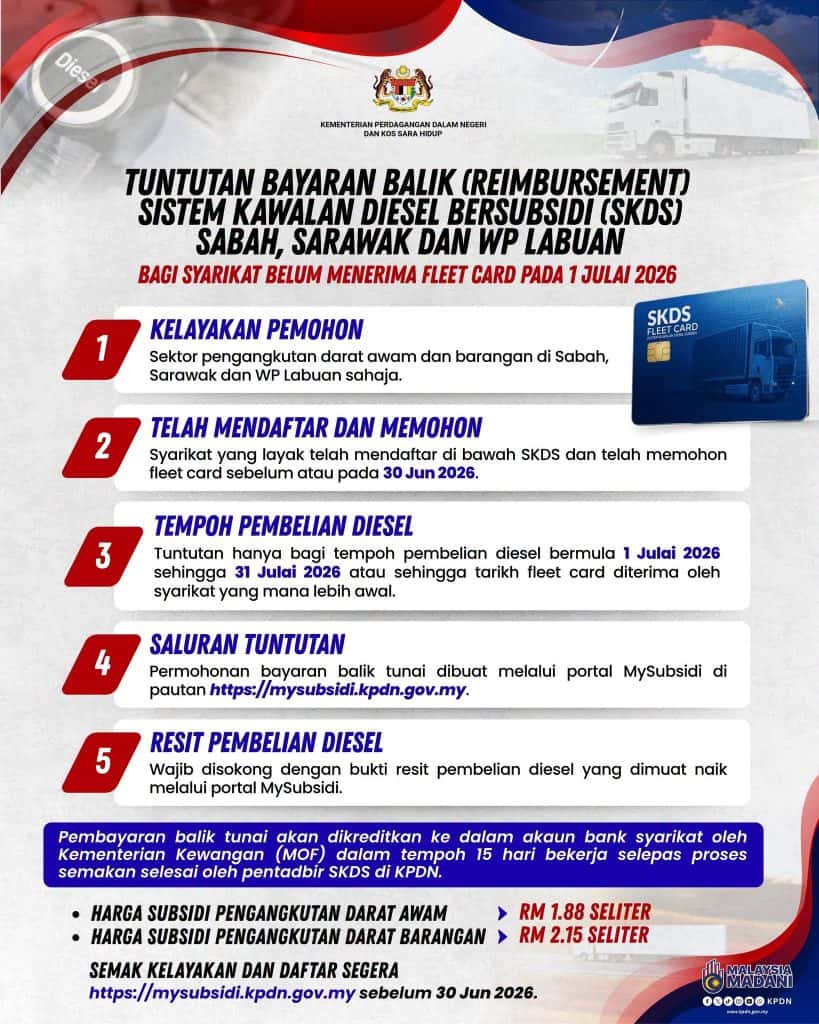
For land and goods public transportation companies have received KPDN approval but have not yet received a physical card (fleet card) from oil companiesThe government has opened the application portal Claim Money Back started July 1, 2026.
The applicant can claim back the difference between the cash price of the diesel purchase receipt and the non-subsidized retail price that was purchased while waiting for the fleet card to arrive.
This claim must be proven by an official gas station purchase receipt and existing SKDS approval documents.
How to Appeal a Quota Increase
If the existing quota is insufficient for daily operations, the company or vehicle owner can still submit a request for an additional quota to the Fuel Subsidy Approval Committee (JKSP).
Appeals can be made via:
Eligible Vehicle Types
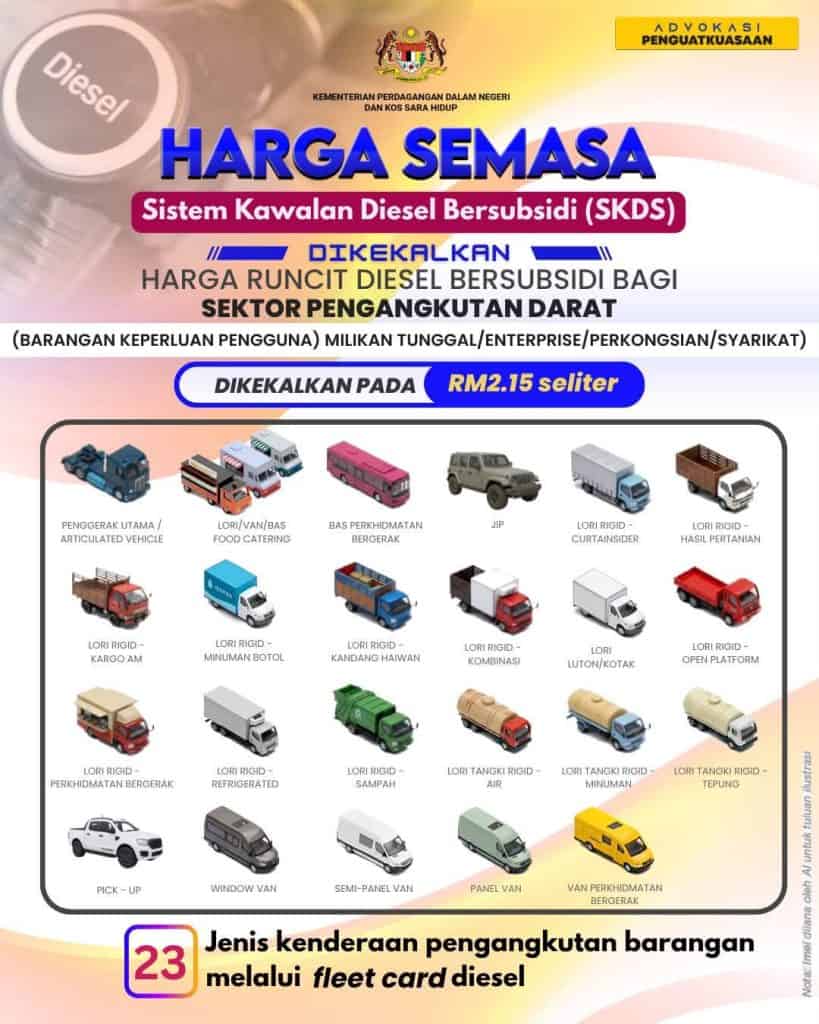
There is 35 types of vehicles who are entitled to apply for SKDS 2.0. This list is divided into 3 main transportation sectors according to the subsidy rates set by the government:
Land Transport Sector (Private Companies – Jeeps and Pickups) – RM2.15 per liter
- SKIRT
- PICK UP
Land Transport Sector (General) – RM1.88 per liter
- Ambulance
- Intermediate bus
- Express bus
- Bassmini
- School bus
- Taxi/Car Rental
- Mortuary van/truck
- The bus stops
- Lori Bomba
- Window
Land Transport Sector (Consumer Goods) – RM2.15 per liter
- In rigid cargo
- Truck cooled
- Prime mover
- Animal cage rigid truck
- Rigid trucks for agricultural products
- Combination rigid lorry
- Water tank rigid truck
- Window
- Panels from
- Lori Luton
- Rubbish rigid truck
- Mobile service bus
- Flour tank rigid truck
- Lori rigid drinks
- Rigid truck mobile service
- Lori’s stiff curtains
- Beverage rigid tank truck
- Bus food catering
- Lori’s rigid open platform
- Mobile service van
- Lori’s food catering
- From food catering
- There are semi panels
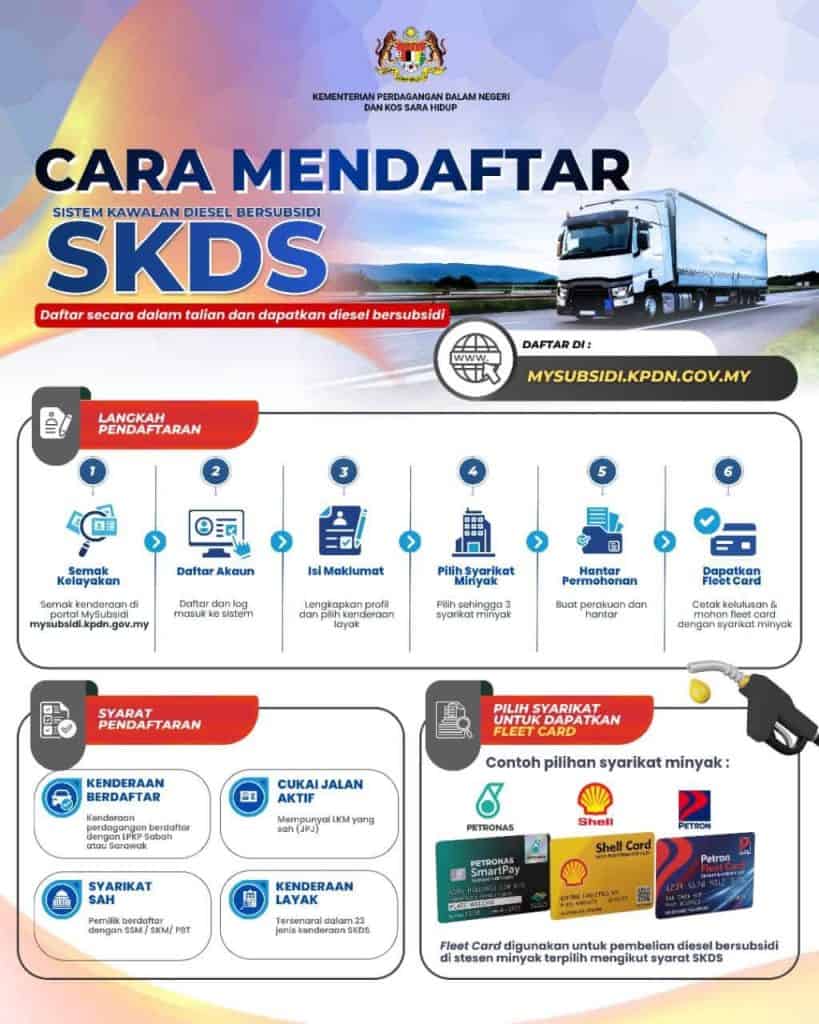
How to Register for SKDS 2.0
- Check Eligibility: Check the vehicle on the MySubsidies portal
- Register Account: Register and log in to the system
- Fill in the Information: Complete the profile and select an eligible vehicle
- Submit Application: Create a certificate and send it
- Submit Application: Create a certificate and send it
- Get a Fleet Card: Print approval & request a fleet card with the oil company
Please see the video below:
MySubsidi Diesel 2.0 Application Guide
Questions & Further Information
For questions and further information regarding MySubsidi Diesel, please refer to:
- Ihsan Madani Portal
- BUDI MADANI DIESEL Portal
- My Diesel Subsidy Portal
- KPDN Official Facebook Site
OR, see the table below:
| Things | Phone number | Email Address |
|---|---|---|
| Application for subsidized Petrol (SKPS) and Diesel (SKDS) quotas | 03 – 8882 5893/5894/5923/6667/6331/6557 | [email protected] |
| SKPS Refund Claim | [email protected] | |
| River Passenger Ship Company Gasoline Refund Claim | [email protected] |
OIL COMPANY
SKDS 2.0 FAQ
No. The quota approval given through the MySubsidi KPDN portal has no expiration date, as long as the vehicle has a valid Road Tax (LKM) and your business entity is still active.
Yes. The KPDN MySubsidi system allows you to choose maximum 3 oil company brands different at the time of application. You can distribute vehicles according to the suitability of the nearest gas station to each truck’s logistics operational route.
Can’t. Allocated diesel liter quotas (between 900L to 5,000L per month) will be updated and reset (reset) every 1st of every month. The remaining quota will be canceled automatically.
You need to do it call the oil company customer service line directly who issued the card (for example Petronas SmartPay or Shell Card) to block the old card and apply for a new replacement card. You don’t need to register again on the KPDN portal.
Starting May 2026, land transportation companies enter Sabah, Sarawak, and WP Labuan can now officially register on the KPDN MySubsidies portal.
Yesprovided that the driver only uses the card for vehicles that show the license plate number and physically match it Fleet Card worry. Use in other vehicles constitutes a breach of trust in the subsidy.
Also read:
PakarPBN
A Private Blog Network (PBN) is a collection of websites that are controlled by a single individual or organization and used primarily to build backlinks to a “money site” in order to influence its ranking in search engines such as Google. The core idea behind a PBN is based on the importance of backlinks in Google’s ranking algorithm. Since Google views backlinks as signals of authority and trust, some website owners attempt to artificially create these signals through a controlled network of sites.
In a typical PBN setup, the owner acquires expired or aged domains that already have existing authority, backlinks, and history. These domains are rebuilt with new content and hosted separately, often using different IP addresses, hosting providers, themes, and ownership details to make them appear unrelated. Within the content published on these sites, links are strategically placed that point to the main website the owner wants to rank higher. By doing this, the owner attempts to pass link equity (also known as “link juice”) from the PBN sites to the target website.
The purpose of a PBN is to give the impression that the target website is naturally earning links from multiple independent sources. If done effectively, this can temporarily improve keyword rankings, increase organic visibility, and drive more traffic from search results.