Knowing the path to becoming a teacher in Malaysia is very important for students who aspire to become educators. Whether you want to become a primary or secondary school teacher, there are several paths to becoming a teacher to choose from depending on your academic qualifications and level of study.
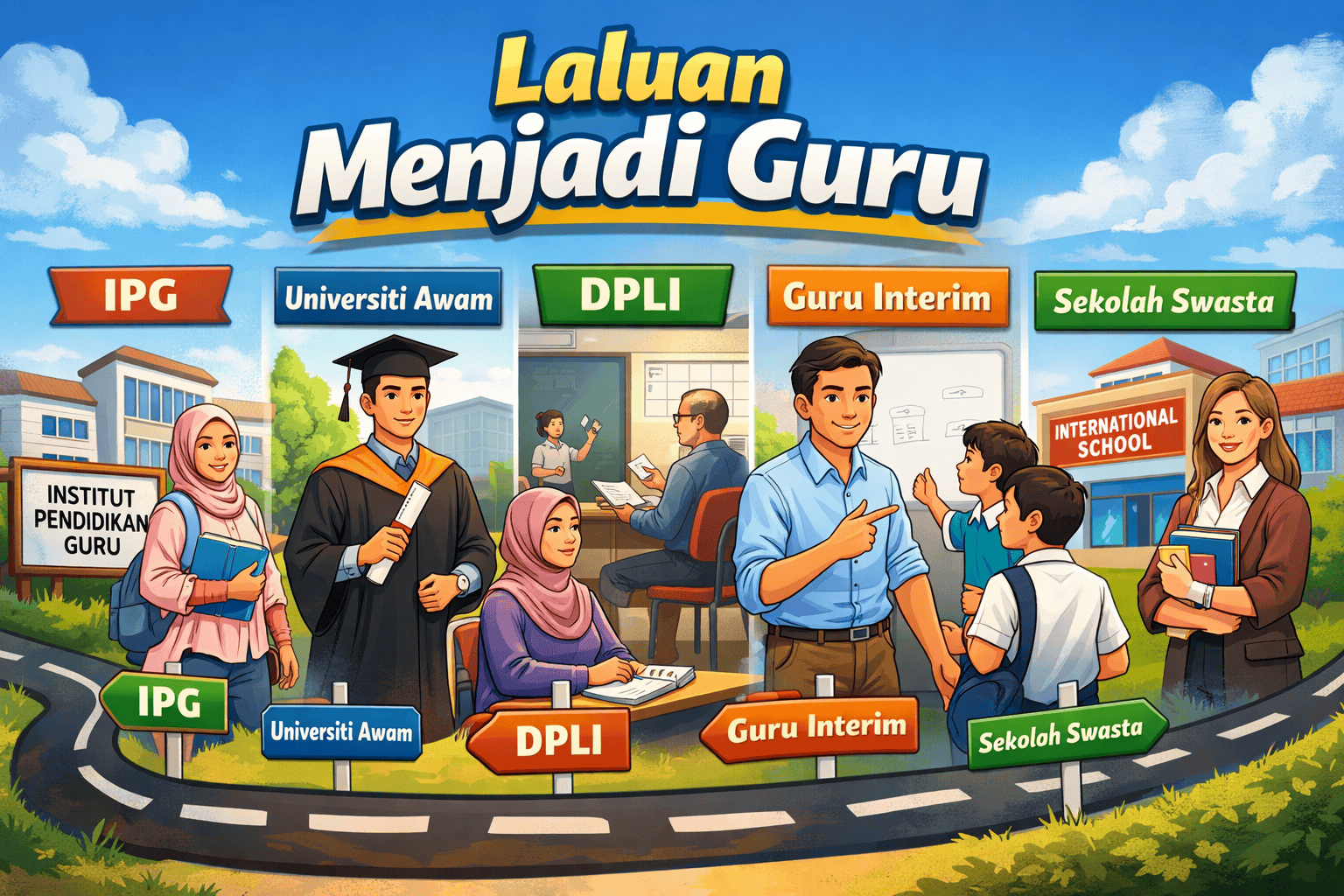
In Malaysia, there are several main routes to becoming a teacher such as through the Teacher Education Institute (IPG), education degrees at state universities, Postgraduate Diploma in Education (DPLI), temporary or substitute teachers and teaching at private or international schools. Each of these pathways has different entry requirements, study periods and career opportunities.
This article will fully explain each path to becoming a teacher so you can choose the path that best suits your interests and career plans.
What is the Path to Becoming a Teacher in Malaysia?
The following are: The main route to becoming a teacher in Malaysia:
- Institute of Teacher Education (IPG)
- Degree in Education at a State University
- Postgraduate Diploma in Education (DPLI)
- Interim Teacher or Substitute Teacher
- Teach at a Private or International School
Every path to becoming a teacher these have different benefits and entry requirements.

5 Ways to Become a Teacher in Malaysia
Becoming a teacher in Malaysia can be achieved through several routes depending on academic qualifications and individual interests. Each pathway has its own entry requirements, length of study, and benefits before one can serve as an educator.
Here are the 5 main paths to becoming a teacher in Malaysia.
1. The Path to Becoming a Teacher Through the Teacher Education Institute (IPG)
One of the most popular path to becoming a teacher in Malaysia It’s finished Institute of Teacher Education (IPG).
Students can apply after SPM through the program Bachelor of Teacher Training Degree Program (PISMP). This program takes approx 4 years.
Advantages of the IPG route:
- Obtained monthly allowance during the study period
- Special teacher training program
- Automatic placement in public schools after graduating
Important conditions
Candidates need to pass several filters such as:
- IPG interview
- Teacher Candidate Qualification Test (UKCG)
This path is very suitable for students who definitely want to become teachers after SPM.
2. The Path to Becoming a Teacher Through State University Education
Apart from IPG, there is one more Path to becoming a teacher in Malaysia It’s finished Bachelor of Education (B.Ed) at a state university.
This route is usually taken after:
Students can choose various educational fields such as:
- Malay Language Education
- History Education
- Mathematics Education
- Science Education
Throughout the studies, students will learn:
- Pedagogy and teaching methods
- Educational psychology
- Practical training at school
However, graduates of this pathway placement is not automatically guaranteed and need to apply for the position through the Education Services Commission (SPP).
3. The Path to Becoming a Teacher Through DPLI
For those with a degree in a field other than education, there is path to becoming a teacher through DPLI (Postgraduate Diploma in Education).
This program usually takes time about 1 year and offered by universities such as:
- University of Malaya (UM)
- Sultan Idris University of Education (UPSI)
Who is suitable to take part in DPLI?
This program is suitable for:
- Prospective graduate changed careers to teaching
- Title holders such as:
- Science
- Biology
- Mathematics
- Language
After completing DPLI, graduates can apply for teacher positions via SPP or temporary position.
4. Path to becoming a teacher as a temporary teacher or substitute teacher
Another path to becoming a teacher is through appointment as interim teacher or substitute teacher.
These positions are usually assigned when available teacher vacancies in schools.
Characteristics of a temporary teacher position:
- Appointed by contract
- Accepted monthly salary
- There is no guarantee of a permanent position
However, this path provides the opportunity to:
- Gather teaching experience
- Understand the school system
- Apply for a permanent position in the future
5. Path to Becoming a Teacher in a Private or International School
Teaching in private or international schools is also one of them becoming a teacher is becoming increasingly popular.
Usually the main conditions are:
- Own degree in a related field
- Fluent in English
Some schools also require additional qualifications such as:
- PGDE (Postgraduate Diploma in Education)
Advantages of this route
- Potential salary higher
- International teaching environment
- Opportunity to teach curriculum abroad
However, teachers need to apply for work directly with the school because there is no placement by the Malaysian Ministry of Education.
Summary of the Path to Becoming a Teacher in Malaysia
| The Path to Becoming a Teacher | Entry Qualifications | Period | Profit |
|---|---|---|---|
| IPG (PISMP) | Graduated from SPM | 4 years | Monthly allowance & placement in state schools |
| University Education Degree | STPM / Matriculation / Foundation | 4 years | Educational professional degree |
| DPLI | A degree is not education | 1 year | Change career to teaching |
| Interim/Substitute Teacher | Relevant degree | Contract | Get teaching experience |
| Private/International Schools | Degree + BI smoothly | Depends | Potentially higher salary |
Duties & Roles of Teachers

Among the duties and roles of teachers are as follows:
1. Teachers as Knowledge Practitioners
Teachers are responsible for instilling knowledge and skills in students to form a culture of knowledge in their lives.
Therefore, teachers need to practice a love of knowledge such as reading, critical thinking, observing, creating, exchanging views and always looking for new experiences to increase knowledge.
2. Teachers as Practitioners of Professional Skills
Certified teachers need to perform tasks such as teaching, mentoring, and co-curricular activities efficiently based on correct educational theories and practices.
This is important to produce a generation that is knowledgeable, skilled, moral and in line with the National Education Philosophy.
3. Teachers as Educators & Reference Experts
Teachers are individuals who are knowledgeable and trained in teaching skills and are responsible for conveying knowledge to students.
Apart from that, teachers also become experts who refer students to various matters, not only related to learning but also emotional, spiritual and general knowledge aspects.
4. Teachers as Agents of Change
Teachers act as agents of change in the education system. This includes implementing a student-centered learning approach, building loving relationships with students and colleagues, and being open and proactive in facing changes in the world of education.
Frequently Asked Questions Path to Becoming a Teacher
In general, a person must have at least a Bachelor’s degree in education or a specialist education qualification such as a Postgraduate Diploma in Education (DPLI).
Apart from that, candidates must also meet the requirements set by the Malaysian Ministry of Education (KPM).
Yes, SPM graduates can apply to the Teacher Education Institute (IPG) through the Bachelor of Teacher Training Program (PISMP). The program takes approximately 4 years and students will receive a stipend for the duration of their studies.
Yes. Graduates with degrees in other fields can undertake a Postgraduate Diploma in Education (DPLI) or other educational programs to gain teaching qualifications.
The duration of study depends on the path chosen. For example, the PISMP program at IPG takes around 4 years, while DPLI usually takes around 1 year.
In some cases, individuals with relevant degrees may work as temporary or substitute teachers. However, to become a permanent teacher in a state school, educational qualifications are usually required.
No. Apart from public schools, teachers can also teach in private schools, international schools or private education centers, depending on their qualifications and skills.
Generally, teachers at international schools must have a degree in education and good English language skills, and sometimes teaching experience is also an advantage.
Also read:
PakarPBN
A Private Blog Network (PBN) is a collection of websites that are controlled by a single individual or organization and used primarily to build backlinks to a “money site” in order to influence its ranking in search engines such as Google. The core idea behind a PBN is based on the importance of backlinks in Google’s ranking algorithm. Since Google views backlinks as signals of authority and trust, some website owners attempt to artificially create these signals through a controlled network of sites.
In a typical PBN setup, the owner acquires expired or aged domains that already have existing authority, backlinks, and history. These domains are rebuilt with new content and hosted separately, often using different IP addresses, hosting providers, themes, and ownership details to make them appear unrelated. Within the content published on these sites, links are strategically placed that point to the main website the owner wants to rank higher. By doing this, the owner attempts to pass link equity (also known as “link juice”) from the PBN sites to the target website.
The purpose of a PBN is to give the impression that the target website is naturally earning links from multiple independent sources. If done effectively, this can temporarily improve keyword rankings, increase organic visibility, and drive more traffic from search results.