
I want to check eligibility to buy a house? The most accurate way is to count Debt Service Ratio (DSR) using the formula used by banks in Malaysia.
Many people still think that housing credit eligibility only depends on the amount of income. In fact, even though the salary is high, a mortgage application can still be rejected if the monthly commitment is too high.
This is the main reason why banks carry out evaluations DSR first before approving a loan. DSR shows the percentage of debt commitment compared to monthly income, thereby determining your actual ability to pay home installments.
In this guide, you will learn how to calculate the feasibility of buying a house using the DSR formula easily, accurately and based on the actual practices of banks in Malaysia.
Loan Eligibility Factors for Buying a Home
In general, there are 3 main factors or components that banks pay attention to when approving an applicant’s mortgage application:
- CTO
- CCRIS
- DSR
This time, let’s take a closer look at what DSR is and how to easily calculate DSR yourself.
What is DSR?

DSR (Debt Service Ratio) is one of the most important factors in determining eligibility to buy a house in Malaysia. Refers to the ratio between total monthly debt commitments and a person’s monthly income. In short, DSR is used by banks to assess whether you are able to pay mortgage installments without financial burden.
Many people think that a high salary is enough to qualify for a mortgage, but in fact the bank is more concerned with the size of the existing commitment. If the debt is too much, the chance of getting a loan remains low even though the income is large.
To understand it better, here are the important points regarding DSR:
- DSR main functions: Measure the applicant’s financial capabilities before the bank approves the loan
- What is assessed: All monthly commitments such as personal loans, cars, credit cards, PTPTN and others
- DSR rates in Malaysia: Around 70% as a general guideline (depending on the bank)
- Lower DSR is better: Shows you have excess income and lower financial risk
- High DSR is risky: Can cause the KPR application to be rejected
Overall, DSR plays a big role in the housing loan approval process. The lower your DSR, the higher your chances of being approved and owning your dream home with more stable finances.
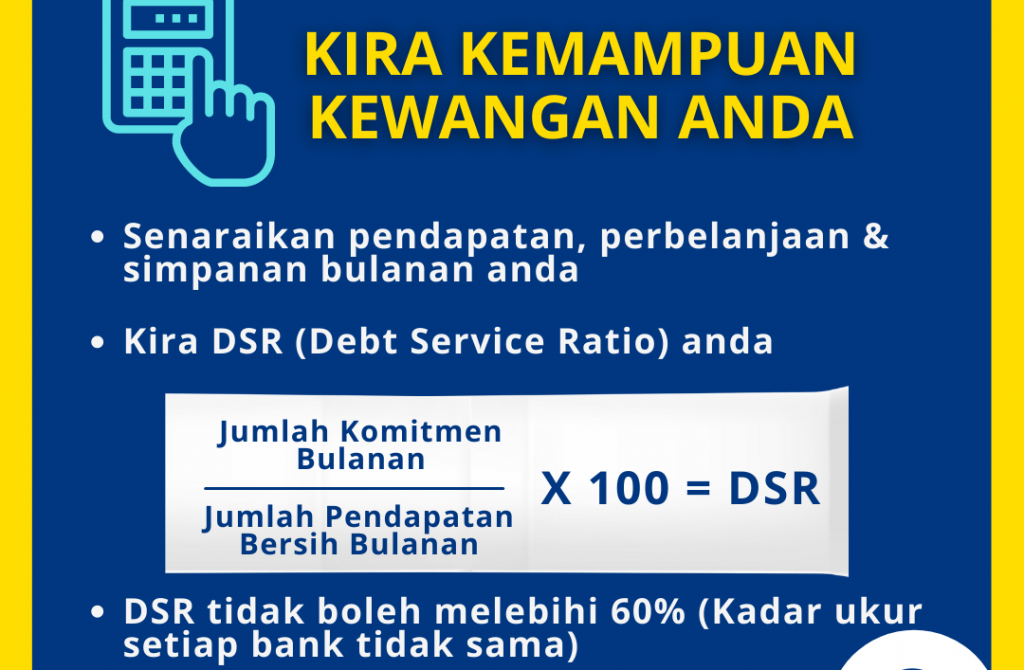
Home Purchase Feasibility Calculation Formula (DSR)
To find out eligibility to buy a houseYou can calculate it yourself Debt Service Ratio (DSR) using a simple formula that is also used by banks in Malaysia.
DSR Formula:
DSR = (Total debt commitments ÷ Monthly income) × 100%
This calculation helps you understand how financially capable you are before applying for a home loan.
In calculating DSR, only certain debt commitments are taken into account, including:
- Car loan
- Existing home loan
- Personal loans
- Credit Card
- PTPTN
- Debt to financial institutions or government agencies
As for monthly income, most banks will take it into account net incomenamely the total salary after deducting mandatory deductions such as:
- EPF (EPF)
- SOCSO (SOCSO)
- EIS
- Another fixed piece
Simply put, the lower your DSR percentage, the higher your chances of being approved for a home loan because it shows your finances are more stable and in control.


Example of How to Calculate DSR Based on Monthly Salary
Individual A
- Monthly income: RM12,000
- Debt commitments: RM4,000 (credit card + personal loan)
DSR Calculation:
DSR = (4,000 12,000) × 100 = 33%
Conclusion:
DSR is in the healthy category and the chance of getting a mortgage is high.
Individual B
- Monthly income: RM9,000
- Debt commitments: RM4,000
DSR Calculation:
DSR = (4,000 9,000) × 100 = 44%
Conclusion:
DSR is still in the good category, but needs to be controlled to avoid the risk of rejection.
IndividualC
- Monthly income: RM5,000
- Debt commitments: RM4,000
DSR Calculation:
DSR = (4,000 5,000) × 100 = 80%
Conclusion:
DSR is included in the high risk category and the possibility of the KPR being rejected is also large.
How to Lower your DSR to Improve Your Home Buying Qualifications
If you want to upgrade eligibility to buy a houseone of the most important steps is to lower the DSR. A low DSR indicates healthy finances and increases the chances of getting a housing loan in Malaysia.
Here are some effective ways to increase your DSR:
1. Pay Debt Consistently & Avoid Maxing Out Credit Cards
The most basic but most important step is to reduce existing debt. If you use a credit card, make sure you pay full amount every monthnot just the minimum payment.
This can prevent debt from increasing and DSR increasing. If you have excess income, use it to reduce your debt balance more quickly.
2. Prove Consistent Income
For those of you who are entrepreneurs or freelancers, the main challenge is to prove a stable income to the bank. Keep notes like:
- bank statement
- Customer payment invoice
- Record monthly transactions
This is important to demonstrate a consistent income stream and increase the bank’s confidence in your financial capabilities.
3. Strong Savings Can Help Afford a Home Loan
Even if your DSR is relatively high, good savings can be an additional factor in favor of implementing it. If there is excess income (e.g. high income month), save it in:
- Fixed deposit
- ASB (Amanah Shares Berhad)
- Savings account
This shows you have good financial discipline.
4. Check your credit score regularly
If you’re unsure about your current financial situation, check your credit score through a platform like CTOS or MyCreditInfo. By knowing your credit score, you can:
- Identify payment problems
- Improve your credit record early on
- Increase the chances of getting a loan
5. Ask for a loan with a strategy
If your application is rejected, don’t give up. Each bank has a different DSR policy. You can still try other banks that may be more suited to your financial profile.
6 Tips for Buying Your First Home in Malaysia
Have you ever wondered why anyone can afford to buy a house as soon as they start working? In fact, they are not just lucky, but have the right knowledge and strategy in financial and real estate planning.
Here are 6 important tips to help improve eligibility to buy a house You:
1. Complete Real Estate Knowledge Before Buying a House
Many people are successful in buying homes early on because they have a strong foundation of real estate knowledge. With knowledge, you can avoid mistakes such as choosing the wrong loan, choosing the wrong type of house or being exposed to fraud. Apart from that, you can also understand important formulas such as DSR and find out which house suits your salary level.
2. Check the feasibility of buying a house with the bank
The most important step is to know your true abilities. You can go to any bank and bring your payslip for loan eligibility check. That way, you will know the price of a house you can afford and can plan your first home purchase before setting your target of owning a second home.
3. Provide sufficient deposit
Lack of savings is often the main reason many people fail to buy a house. Deposits are usually around 10% of the house price, so it’s important to start saving early. The greater your savings, the higher your chances of owning a home without financial stress.
4. Maintain CCRIS Records & Financial Commitments
Good CCRIS records are very important in loan approval. If you have arrears such as PTPTN, this can affect your chances of getting a mortgage. Make sure you make payments consistently or talk to the relevant parties to restructure payments.
5. Control and Improve DSR (Debt Service Ratio)
DSR plays a big role in determining loan eligibility. Avoid taking on too many commitments such as personal loans or expensive cars as they will increase the DSR. The lower the DSR, the higher the chance of the mortgage being passed.
6. Postpone ASB financing if you want to buy a house
If you are planning to buy a house in the near future, it is best to hold off on ASB Financing. The reason is, additional commitments can affect the CCRIS record and increase the DSR, thereby affecting the chances of home loan approval.
Source: Azizul Azli
Frequently Asked Questions Regarding DSR in Malaysia
You can check DSR online via three main platforms, namely CTOS, eCCRIS (Bank Negara Malaysia) and MyCreditInfo (Experian). CTOS and MyCreditInfo provide credit reports as well as commitment estimates, while eCCRIS displays official loan records but requires you to calculate the DSR manually.
Visit the CTOS website, sign up for a free account and check your credit report. In the report, you can see all your loans, credit cards, and payment history. Some reports also show DSR estimates.
Register an account on the eCCRIS website and download a credit report from Bank Negara Malaysia. This report displays all monthly commitments. You need to calculate your own DSR using a formula based on your total commitment and monthly income.
Yes, you can use MyCreditInfo to get a complete credit report. This report includes monthly debt and commitment information that can be used to assess your DSR.
The DSR formula is:
DSR = (Total monthly commitment Monthly revenue) × 100
Used to measure your financial capabilities before applying for a loan.
It depends on the bank’s policy. Some banks use net profit (after deductions), some use gross profit.
No. Each bank has different DSR evaluation methods and conditions. Therefore, loan approval results between banks may not be the same even if the loan amount is the same.
Yes, most banks will consider side income, but it depends on established evidence and conditions such as transaction records or supporting documents.
In general, a DSR below 40% is considered excellent. DSR between 41% and 60% is still acceptable, depending on the bank’s assessment.
There is still a chance to qualify even with a high DSR, depending on other factors such as high income, good credit record, and longer loan term.
Not all. Usually only financial commitments that are recorded and can be proven such as personal loans, car loans, credit cards, PTPTN and commitments as guarantors will be taken into account in the DSR calculation.
Also read:
PakarPBN
A Private Blog Network (PBN) is a collection of websites that are controlled by a single individual or organization and used primarily to build backlinks to a “money site” in order to influence its ranking in search engines such as Google. The core idea behind a PBN is based on the importance of backlinks in Google’s ranking algorithm. Since Google views backlinks as signals of authority and trust, some website owners attempt to artificially create these signals through a controlled network of sites.
In a typical PBN setup, the owner acquires expired or aged domains that already have existing authority, backlinks, and history. These domains are rebuilt with new content and hosted separately, often using different IP addresses, hosting providers, themes, and ownership details to make them appear unrelated. Within the content published on these sites, links are strategically placed that point to the main website the owner wants to rank higher. By doing this, the owner attempts to pass link equity (also known as “link juice”) from the PBN sites to the target website.
The purpose of a PBN is to give the impression that the target website is naturally earning links from multiple independent sources. If done effectively, this can temporarily improve keyword rankings, increase organic visibility, and drive more traffic from search results.
